Call center AI software uses machine learning and natural language technologies to help contact centers serve customers faster, more consistently, and with less effort from agents and supervisors. When implemented thoughtfully, an omnichannel contact center service can elevate customer experience, reduce operational costs, and unlock better insights across every interaction.
Understanding call center AI software pricing is important when planning adoption. Costs can vary based on features, number of agents, interaction volumes, and integrations. Reviewing pricing upfront helps organizations make informed decisions, scale effectively, and ensure that AI investments deliver measurable improvements for both customers and staff.
This guide explains what call center AI software is, where it delivers the most value, and how to choose and roll it out in a way that supports your people and your customers.
What is call center AI software?
AI-based call center software is a set of tools that applies AI to common contact center workflows such as routing, self-service, knowledge retrieval, quality monitoring, and post-call work. It typically includes one or more of the following capabilities:
- Virtual agents for automated self-service in chat and voice.
- Agent assist that suggests answers, steps, and next best actions during live interactions.
- Speech analytics and text analytics that extract insights from calls, chats, and emails.
- Automated quality management that evaluates a larger share of interactions than manual QA can.
- Workforce tools that support forecasting, scheduling, and adherence (often paired with AI insights).
- Summarization and after-call work automation to reduce repetitive documentation.
Many organizations adopt these capabilities in stages, starting with the highest-impact workflows such as call summarization and agent assist, then expanding into self-service and broader analytics. A call center AI can provide real-time agent support and operational insights that improve efficiency and customer satisfaction.
Contact centers that implement an artificial intelligence call center approach often see faster handling times, better consistency, and more actionable data from every interaction.
Top AI Call Center Software Platforms
1. Bright Pattern – Leader in Omnichannel AI & Intelligent Automation

Bright Pattern’s AI-based call center software combines conversational AI, real-time agent assist, predictive routing, and deep analytics into a single platform. It supports voice, chat, email, SMS, and messaging channels all in one place, enabling seamless omnichannel experiences and better agent productivity. The platform uses advanced speech recognition, natural language processing, predictive insights, and automation to reduce wait times, improve customer satisfaction, and scale operations efficiently.
Bright Pattern also offers seamless integration with CRMs, helpdesk platforms, and marketing automation tools, giving teams a unified view of customer interactions. Its AI-driven quality management automatically scores interactions and identifies coaching opportunities, helping managers improve agent performance consistently. In addition, Bright Pattern’s self-service automation allows customers to resolve routine inquiries quickly while freeing agents to handle more complex issues.
2. Talkdesk Contact Center — Scalable Cloud AI Solutions
Talkdesk provides AI-driven automation and analytics built for scaling customer support. Its real-time insights and virtual agent capabilities help teams deliver consistent service across channels.
3. Nextiva Contact Center — Intelligent Routing & Unified Communications
Nextiva uses AI to route interactions intelligently and combine voice, SMS, and chat into a cohesive support experience — ideal for teams that want smart automation with robust communication tools.
4. Creovai AI Contact Center — Real-Time Agent Enhancement
Creovai focuses on real-time agent support, offering AI-driven coaching, performance guidance, and compliance alerts that help agents perform better during live interactions.
5. Voiso AI Call Center — Global Call Routing & Multi-Region Support
Voiso specializes in AI-powered international call routing, helping multi-region contact centers handle calls efficiently with intelligent distribution and automation.
6. Genesys Cloud CX — AI Experience Orchestration
Genesys Cloud CX uses AI to map and personalize customer journeys across all touchpoints. Its predictive analytics and automation make it a top choice for large enterprises with complex support needs.
7. Convin.ai — Real-Time Monitoring & Analytics
Convin.ai focuses on live monitoring and quality assurance with AI, helping contact centers analyze calls for trends, compliance, and agent performance insights.
8. Observe.AI — AI-Driven Call Analysis
Observe.AI applies speech and sentiment analytics to interactions, turning conversation data into actionable insights for training, coaching, and quality improvements.
How Bright Pattern Stands Out
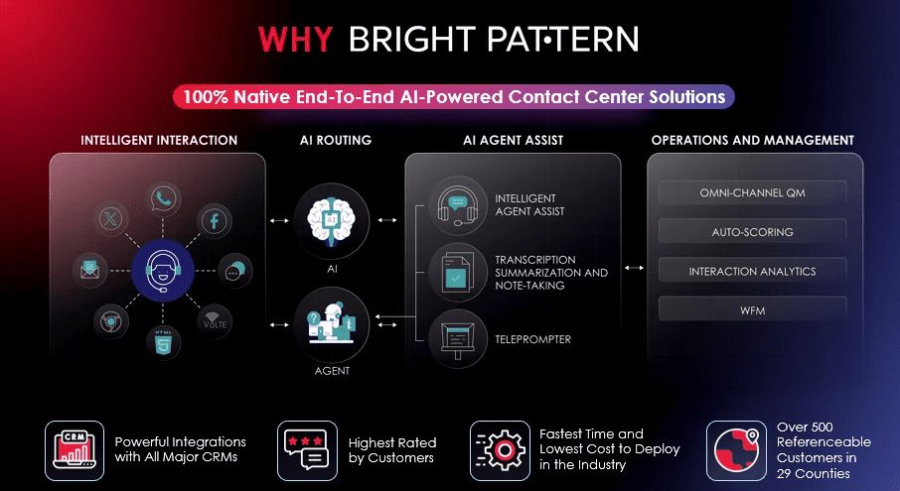
- Unified Omnichannel AI: Built-in voice, chat, email, SMS, and messaging in one dashboard.
- Real-Time Agent Assist: AI suggestions and intent interpretation help agents deliver faster, more accurate responses.
- Advanced Analytics: AI-driven conversation analytics and performance insights help refine processes and boost customer experience.
- Scalable & Flexible: Designed for small teams to large enterprises alike, with deep CRM and SaaS integration.
- Automation Across Workflows: From predictive routing to self-service bots and workflow automations — reducing repetitive tasks.
- Quality Management & Coaching: Automatically scores agent interactions and highlights training opportunities.
- Self-Service Automation: Reduces workload for agents while giving customers quick answers for routine inquiries.
Why call center AI software is a high-impact investment
Contact centers sit at the intersection of customer experience, revenue protection, and brand reputation. AI helps teams improve performance by making interactions easier to handle, improving consistency, and turning conversations into actionable operational data.
Customer experience benefits
- Faster resolutions through smarter routing, better knowledge discovery, and guided workflows.
- More consistent service with real-time prompts that help agents follow the right policy and tone.
- 24/7 support options via virtual agents for common requests and status checks.
- Improved accessibility when speech-to-text and text-to-speech help serve more customers effectively.
Agent and supervisor benefits
- Less cognitive load because the system can surface relevant policy snippets, scripts, and steps while the agent focuses on empathy and problem-solving.
- Reduced after-call work with automatic summaries and suggested disposition codes, where appropriate.
- More targeted coaching using analytics that identify patterns such as repeated compliance misses or knowledge gaps.
- Better onboarding since new agents can rely on consistent guidance and curated knowledge paths.
Operational benefits
- Lower average handle time (AHT) when agents find answers faster and complete wrap-up faster.
- Higher first-contact resolution (FCR) when routing and guidance reduce unnecessary transfers.
- Broader QA coverage by analyzing more interactions than manual sampling can.
- Better root-cause visibility through trend detection in reasons for contact, sentiment, and customer effort.
Core features to look for in call center AI software
Not every contact center needs the same AI stack. A strong evaluation starts with the workflows you want to improve, then maps those needs to product capabilities.
1) Agent assist (real-time guidance)
Agent assist tools listen to the conversation (voice) or read the message (digital) and suggest relevant knowledge articles, checklists, and next steps. The best experiences are:
- Context-aware, using customer intent and case history where available.
- Low-friction, so suggestions appear clearly without overwhelming the agent.
- Explainable, so agents understand why a suggestion is shown.
2) Conversation intelligence (speech and text analytics)
Conversation intelligence turns unstructured conversations into searchable insights. Common outputs include:
- Topics and reasons for contact (for operational improvements).
- Sentiment signals (to flag escalation risk and coaching opportunities).
- Compliance markers (to detect required disclosures or risky phrases).
- Customer effort indicators (to identify friction points in processes).
3) Automated quality management
AI-assisted QA can score more interactions, highlight moments that need human review, and standardize evaluations. This supports:
- Fairer coaching by using consistent criteria.
- Faster feedback loops that help agents improve sooner.
- Risk reduction by increasing visibility into compliance-related behaviors.
4) Virtual agents and self-service automation
Virtual agents can handle common tasks such as password resets, order status, appointment scheduling, and simple troubleshooting. Strong implementations typically include:
- Clear escalation paths to a human agent when needed.
- Well-scoped intents that focus on high-volume, low-variance requests.
- Continuous tuning based on real customer transcripts and outcomes.
5) Summarization and after-call work automation
AI summaries can reduce time spent writing notes and help keep records consistent. Effective solutions support:
- Structured summaries (issue, steps taken, resolution, next steps).
- Easy editing so agents can correct and finalize outputs.
- Auditability by retaining relevant interaction context.
6) Knowledge management and search
AI improves knowledge discovery by ranking relevant answers and extracting snippets. Benefits include:
- Fewer holds while agents search for the right policy.
- More consistent answers across teams and shifts.
- Faster content improvement by identifying articles that cause confusion.
High-value use cases by contact center type
Different industries and service models see different early wins. The table below highlights common starting points.
| Contact center environment | Common challenges | AI use cases that often deliver quick wins |
|---|---|---|
| High-volume customer support | Long queues, repetitive questions, agent fatigue | Virtual agents for FAQs, agent assist, summarization, smarter routing |
| Technical support | Complex troubleshooting, inconsistent adherence to steps | Guided workflows, knowledge surfacing, conversation analytics for root-cause trends |
| Billing and account services | Compliance requirements, high customer frustration | Automated QA flags, real-time compliance prompts, sentiment-based escalation |
| Sales and retention | Inconsistent pitch, missed objections, variable outcomes | Real-time next best actions, call coaching insights, talk-to-listen balance analytics |
| Back office plus contact center | Slow handoffs, duplicate work, unclear accountability | Case summarization, workflow automation, contact reason tagging for process fixes |
What success looks like: outcomes to measure
The most persuasive AI business cases connect capabilities to measurable outcomes. Common metrics include:
- Customer satisfaction (CSAT) or net promoter score (NPS), where used.
- First-contact resolution (FCR) to track fewer follow-ups and transfers.
- Average handle time (AHT), especially time spent searching knowledge and completing wrap-up.
- Cost per contact based on channel mix and automation success.
- Containment rate for self-service (with careful monitoring of escalation quality).
- QA scores and compliance adherence coverage across more interactions.
- Agent retention and time to proficiency for new hires.
To keep measurement fair, compare similar time windows and contact types, and track both productivity and experience outcomes. For example, improvements in AHT are most valuable when CSAT stays steady or improves.
Example scenarios: how teams use call center AI software in practice
The following scenarios are representative ways contact centers apply AI. They are meant to illustrate realistic workflows rather than describe any specific organization.
Scenario A: Faster answers with agent assist
A customer calls with a policy question that typically requires searching multiple knowledge articles. Agent assist detects the intent and surfaces a short, approved answer snippet and a step-by-step checklist. The agent confirms details, explains the policy clearly, and resolves the issue without placing the customer on hold.
Benefit: faster resolutions and more consistent messaging, especially for newer agents.
Scenario B: Reduced after-call work with structured summaries
After a call, the system generates a structured summary with the reason for contact, troubleshooting steps taken, resolution, and follow-up actions. The agent reviews, edits if needed, and saves. The summary is consistent, easy to read, and supports better handoffs if the customer calls again.
Benefit: less repetitive typing and cleaner records that improve continuity.
Scenario C: Coaching based on conversation trends
Supervisors use analytics to identify that a specific product issue is driving a spike in contacts. They also see that certain explanations correlate with lower customer frustration signals. The team updates a talk track and knowledge article, then tracks the impact on repeat contacts and escalations.
Benefit: coaching and content updates become proactive rather than reactive.
How to choose the right call center AI software
Selection is easiest when you anchor on your operating model and data reality. A strong evaluation process typically includes these steps:
1) Start with the workflows that matter most
Pick two or three workflows with clear pain and measurable outcomes, such as:
- Knowledge search during calls
- After-call documentation
- QA coverage and consistency
- High-volume repetitive contacts suitable for automation
2) Validate channel support
Many contact centers are omnichannel. Confirm the solution supports your current and planned channels, such as voice, chat, email, and messaging, and that insights can be compared across channels.
3) Check integration fit
Call center AI works best when it fits into daily tools. Common systems to align with include:
- Contact center platform (telephony and digital channels)
- CRM and case management
- Knowledge base
- Workforce management and QA tools
Prioritize solutions that reduce agent tab-switching and keep context connected across systems.
4) Evaluate data handling and governance
AI features depend on interaction data. Key considerations include:
- Transcription quality for your accents, jargon, and domain terminology.
- Security controls such as role-based access and audit logs.
- Data retention and policies for storing recordings and transcripts.
- Privacy support for redaction or masking of sensitive information when required.
5) Demand proof through a pilot with clear success criteria
A pilot should be designed to prove outcomes, not just demonstrate features. Include:
- Defined contact types and teams
- Baseline metrics and target improvements
- A plan for agent training and feedback
- Human review for summaries, QA flags, and automation flows
Implementation roadmap: a practical rollout plan
A phased rollout helps teams build confidence and deliver wins early.
Phase 1: Foundation and quick wins
- Data readiness: confirm recording, transcription, and tagging are reliable.
- Knowledge cleanup: ensure top articles are accurate, current, and easy to parse.
- Summarization pilot: reduce after-call work while keeping agents in control through review and editing.
Phase 2: Real-time assistance and QA scaling
- Agent assist for top intents and procedures.
- Automated QA triage to surface calls needing review.
- Coaching workflows that translate insights into action.
Phase 3: Self-service expansion
- Virtual agent for high-volume, well-defined intents.
- Smart escalation that passes context and summaries to human agents.
- Continuous optimization using containment outcomes and customer feedback.
Best practices for adoption and change management
AI succeeds when people trust it. These practices help build adoption while maintaining service quality.
- Position AI as support, not replacement: focus on reducing repetitive work and improving consistency.
- Involve agents early: ask frontline teams which workflows slow them down and test solutions with them.
- Keep humans in the loop: require review for summaries and allow agents to override suggestions.
- Create feedback loops: make it easy to flag incorrect suggestions and improve knowledge content.
- Train for judgment: teach when to rely on AI and when to escalate or verify.
Common buying checklist
Use this checklist to compare vendors and narrow options.
- Accuracy and relevance in agent assist suggestions for your top contact reasons
- Transcription performance for your real call conditions and terminology
- Workflow fit that reduces screen switching and speeds tasks
- Customizability for intents, QA scorecards, and knowledge sources
- Reporting that links AI outputs to business outcomes (AHT, FCR, CSAT)
- Governance including access control, retention options, and audit trails
- Implementation support and clarity on what your team must configure internally
Bottom line
Call center AI software can meaningfully upgrade the customer and agent experience by accelerating resolutions, improving consistency, and turning conversations into operational intelligence. The strongest results come from focusing on a few high-impact workflows first, measuring outcomes carefully, and expanding in phases as adoption grows.
If your goals include better service at scale, faster onboarding, and more actionable insight from every interaction, call center AI software is one of the most practical ways to modernize operations while supporting the people who deliver your customer experience every day.
